
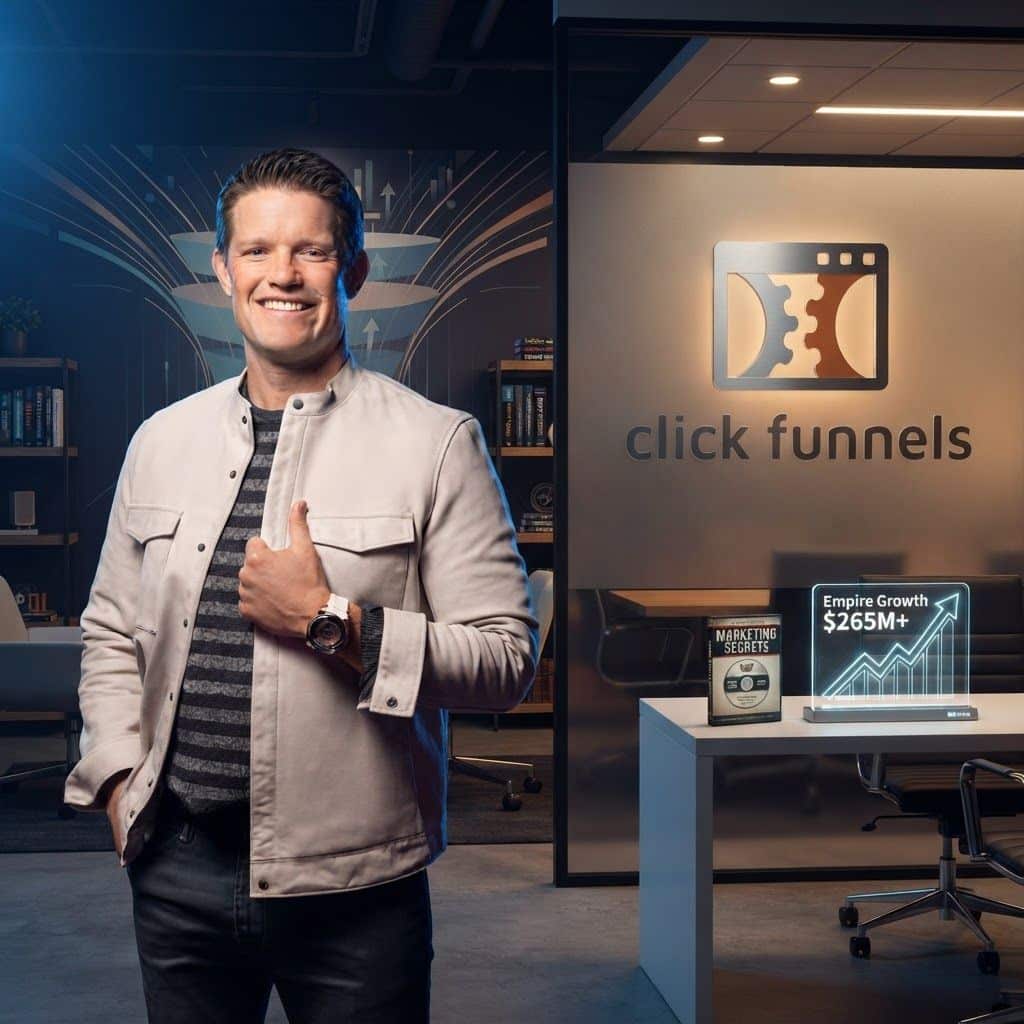
For small-business owners, attracting customers is only half the battle. The real challenge is turning website visitors into qualified leads, converting those leads into paying customers, and generating consistent revenue.
Unfortunately, many businesses spend significant amounts of money driving traffic to websites that aren’t designed to convert.
That’s where ClickFunnels offers a different approach.
Founded by Russell Brunson and Todd Dickerson, ClickFunnels is a marketing and sales funnel platform designed to help businesses guide potential customers through a structured buying journey.
Instead of relying on a traditional website where visitors can become distracted or leave without taking action, ClickFunnels emphasizes focused landing pages, compelling offers, automated follow-ups, and conversion optimization.
For small businesses operating with limited marketing budgets, these strategies can be particularly valuable.
Let’s explore seven ClickFunnels marketing strategies and why they can be so effective for small-business growth.
1. Turn Website Visitors Into Customers With Sales Funnels
One of the central principles behind ClickFunnels is that generating website traffic doesn’t automatically generate sales.
A traditional website often contains numerous links, pages, and navigation options. While useful for providing information, this structure can distract visitors from taking a specific action.
A sales funnel takes a more focused approach.
It guides prospects through a series of steps designed to move them closer to becoming customers.
A simple sales funnel might include:
- A landing page highlighting a valuable offer
- A form collecting contact information
- A page introducing a product or service
- A checkout or appointment scheduling page
- A follow-up email sequence
For example, a local roofing company could use a funnel offering a free roof inspection.
Visitors enter their contact information, learn about the company’s services, and receive an opportunity to schedule an appointment.
Each step encourages one specific action.
Why it works for small businesses: A focused sales process reduces unnecessary distractions and gives business owners a clearer way to measure and improve conversions.
2. Use Lead Magnets to Generate Qualified Leads
Successful marketing begins with attracting the right audience.
ClickFunnels promotes using lead magnets to encourage potential customers to share their contact information.
A lead magnet is something valuable offered in exchange for an email address or other contact details.
Examples include:
- A landscaping company offering a seasonal lawn care guide
- A fitness trainer providing a free workout plan
- A real estate agent offering a homebuyer’s checklist
- A marketing consultant providing a free website evaluation
- A financial professional offering a budgeting worksheet
The best lead magnets solve a specific problem for a clearly defined audience.
ClickFunnels explains this strategy in its guide to lead generation sales funnels.
Once prospects subscribe, businesses can continue communicating with them through educational content and relevant offers.
Why it works: Lead magnets create an opportunity to establish trust before asking potential customers to make a financial commitment.
3. Build Customer Relationships With the Value Ladder
One of Russell Brunson’s best-known marketing concepts is the Value Ladder.
The strategy involves offering products or services at progressively higher price points while delivering increasing value.
Rather than expecting a new prospect to immediately purchase an expensive service, businesses introduce an accessible starting offer.
For example, a digital marketing agency might create the following Value Ladder:
- Free offer: Website performance checklist
- Entry-level offer: $99 website audit
- Core service: $1,500 website redesign
- Premium service: Ongoing marketing and SEO management
Each step helps customers solve a larger problem and develop greater confidence in the business.
This concept is explained in ClickFunnels’ article, The Value Ladder Explained.
The objective is to build long-term customer relationships rather than focusing exclusively on one-time transactions.
Why it works: Small businesses can increase customer lifetime value by offering additional solutions that naturally complement their existing services.
4. Automate Email Marketing and Customer Follow-Ups
One of the biggest challenges for small-business owners is finding enough time to consistently follow up with prospective customers.
Many potential sales are lost simply because businesses fail to maintain communication.
ClickFunnels supports email marketing and automated customer follow-up workflows.
For example, when someone downloads a free guide, a business could automatically send:
- Day 1: The requested resource and a welcome message
- Day 3: Helpful tips related to the customer’s problem
- Day 5: A customer testimonial or case study
- Day 7: An invitation to schedule a consultation
- Day 10: A follow-up with another useful resource
This communication helps nurture prospects without requiring the business owner to manually contact every individual.
However, email campaigns should follow applicable consent and unsubscribe requirements.
Why it works: Automated follow-ups help businesses maintain consistent communication, educate potential buyers, and identify customers who are ready to purchase.
5. Increase Revenue With Upsells and Additional Offers
Generating more revenue doesn’t always require attracting more customers.
Another strategy emphasized by ClickFunnels is increasing the average value of each transaction.
This can be accomplished through upsells, complementary products, and additional service packages.
For example, an online retailer selling a $75 skincare product might offer a complementary moisturizer during checkout.
A business consultant selling a $199 training program might offer a personalized strategy session as an additional purchase.
ClickFunnels supports features such as order bumps and one-click upsells designed to introduce relevant offers during the purchasing process.
Its guide to maximizing sales conversion funnels explores how additional offers fit into a broader revenue strategy.
The important consideration is relevance.
Additional products should genuinely benefit the customer rather than create unnecessary pressure.
Why it works: Increasing average order value can improve revenue without requiring a proportional increase in advertising spending.
6. Improve Marketing Performance With A/B Testing
One of the most valuable lessons small businesses can learn from ClickFunnels is the importance of testing marketing campaigns.
Business owners often make assumptions about which headlines, images, offers, or calls to action will perform best.
A/B testing replaces some of that guesswork with measurable results.
For example, a local cleaning company might test two landing page headlines.
Version A: Professional House Cleaning Services
Version B: Enjoy a Spotless Home Without Spending Your Weekend Cleaning
Both versions promote the same service, but the second emphasizes the customer’s desired outcome.
By measuring how many visitors request estimates from each page, the company can determine which message performs better.
ClickFunnels provides A/B testing tools for comparing variations of marketing assets.
Why it works: Testing can help small businesses improve conversion rates and get more value from their existing marketing traffic. Reliable conclusions require enough data, so businesses should avoid overreacting to small samples.
7. Focus on Conversions Instead of Just Website Traffic
One of the biggest mistakes small businesses make is measuring marketing success primarily through website visits, social media followers, or impressions.
While these numbers can provide useful information, they don’t necessarily translate into revenue.
ClickFunnels encourages a conversion-focused mindset.
Important marketing metrics include:
- Landing page conversion rate
- Cost per lead
- Lead-to-customer conversion rate
- Customer acquisition cost
- Average order value
- Customer lifetime value
Consider a business receiving 1,000 website visitors per month.
If only 1% become leads, the business generates 10 leads.
Improving the conversion rate to 3% would generate 30 leads from the same traffic.
That’s three times as many opportunities without increasing website visitors.
Of course, lead quality and customer acquisition costs still matter.
Why it works: Conversion optimization allows businesses to focus on measurable results and potentially improve the return on their existing marketing investments.
Why ClickFunnels Marketing Strategies Work for Small Businesses
Small businesses rarely have unlimited advertising budgets, large sales departments, or dedicated marketing teams.
That’s why having a structured customer acquisition process can be so valuable.
ClickFunnels marketing strategies emphasize several fundamental principles:
- Attract the right potential customers
- Give visitors a clear reason to take action
- Capture and nurture qualified leads
- Build trust before asking for larger purchases
- Increase the value of customer relationships
- Automate repetitive marketing activities
- Measure performance and continuously improve
These principles can work across numerous industries, including home services, consulting, coaching, e-commerce, professional services, and online education.
However, ClickFunnels isn’t a guaranteed solution for every company.
Businesses still need competitive offers, relevant traffic, effective messaging, and profitable economics. They should also evaluate software costs against their actual needs.
The real advantage comes from implementing a well-designed marketing system—not simply purchasing a software subscription.
Final Thoughts: Why Small Businesses Should Understand Sales Funnels
ClickFunnels has helped popularize an important idea in digital marketing: attracting attention is only the beginning of the customer journey.
Successful businesses need systems that turn interest into meaningful relationships and ultimately into sales.
By combining targeted landing pages, valuable lead magnets, automated follow-ups, conversion testing, and strategic offers, small businesses can develop more organized and measurable marketing campaigns.
Even business owners who don’t use ClickFunnels can benefit from understanding these principles.
For entrepreneurs looking to explore the platform and its educational resources, visit the official ClickFunnels website or read its guide to sales funnel development.
The goal isn’t simply to attract more traffic.
It’s to turn more of the right visitors into loyal, profitable customers.
Frequently Asked Questions About ClickFunnels
What is ClickFunnels used for?
ClickFunnels is a marketing platform that helps businesses build landing pages, sales funnels, lead generation campaigns, and automated customer journeys designed to support conversions and sales.
Is ClickFunnels good for small businesses?
ClickFunnels can be useful for small businesses that generate leads or sell products and services online. Its value depends on the company’s marketing goals, available budget, and ability to attract qualified traffic.
What is a sales funnel in digital marketing?
A sales funnel is a structured process that guides prospective customers from initial awareness to taking an action, such as submitting an inquiry, booking an appointment, or purchasing a product.
Can ClickFunnels help increase sales?
ClickFunnels provides tools and strategies that can support lead generation, customer follow-ups, and conversion optimization. Actual sales results depend on the strength of the offer, audience targeting, traffic quality, and execution.
Do you need ClickFunnels to create a sales funnel?
No. Sales funnels can be built using many different marketing tools. ClickFunnels is one platform designed to simplify the process by combining several funnel-related capabilities.